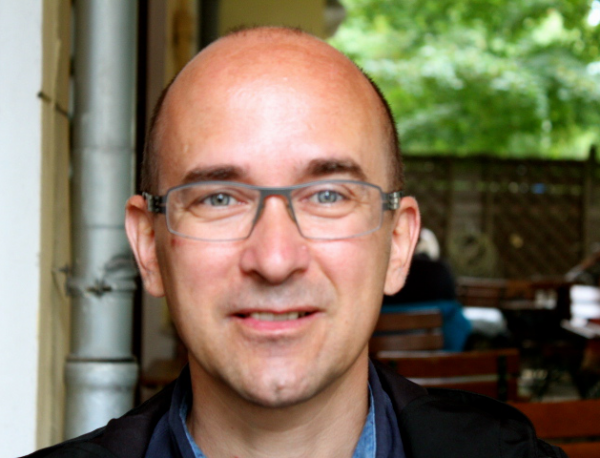
Buerger Energie Berlin’s Steffen Walter.
Photo courtesy: krytykapolityczna.pl
A group of Berlin citizens is trying to do something that has never been done on a grand scale before.
Buerger Energie Berlin is a co-op of about 700 members who are bidding for the rights to own and operate the city’s electricity grid, which supplies about 2.5 million homes.
Although some smaller co-ops have taken control of the grids in small towns around Germany, including at Schoenau which now runs its own electricity utility, never before has a bid been made for such a large take-over. The new 20-year contract for Berlin’s grid is up for grabs at the end of next year.
While success is a long shot it is the sentiment that is proving to be making the difference, showing that community groups have not only the desire but the impetus to take on big organisations and big tasks.
The co-op estimates it will need about €200 million to be a serious contender and has already collected around €8 million from contributions by the 700-odd members who all paid €500 each.
Buerger Energie also has more than 1000 people who are considered supporters because the money they have contributed will be refunded if the bid to buy the grid fails. Sustainable banks are considering helping to finance the operation.
While a Dutch municipal group Alliander looks to be the strongest contender, Buerger Energie is hoping to acquire even a share in the grid – ideally 49 per cent – if it cannot buy the whole thing.
It also hopes that the current owner Vattenfall, a Swedish state company that has interests in fossil fuel, will not be successful.
The Berlin grid has 35,000km of powerlines – mostly underground – and is valued at about €1 billion.
The response to the bid has been varied.
“It’s mixed,” says Steffen Walter, who has been with the co-op since the early days and was one of the 30 founding members.
“They say it’s ok that a player comes from outside and just redefines the boundary of what’s possible, to shake the old processes up a bit.
“On the other side, the process might get too restrictive for us to remain in the running until the end.
“We don’t know if our government will remain will be flexible enough to really (do it). In the governing coalition there are mixed feelings about it. The social democrats are more open to us, to a co-operative interest; the Christian Democrats they are rather reluctant. There are disputes and debates going on within the governing coalition.”
The biggest hurdle right now, with about a year until the decision is made, is to determine exactly how the co-op plans to operate its business and find the experts needed to make it all possible.
“We are an initiative with roots in NGOs. We are not energy experts. We need partners with expertise. We need technical expertise. We are not the grid experts,” Walter says.
Buerger Energie also wants to promote renewable energy either through generation or supply but that would require forming a separate legal entity. There are already about 800 renewable energy organisations in Gemany. Unfortunately many relied on the high feed-in tariff – it started just below €1 euro, but has fallen to around 12 cents and is too low for many projects to be viable.
Now the time has come where co-ops are realising that integrating with the grid is the key to success.
“We want to promote anything to do with a transition to renewables,” Walter says.
“We need to take this one step further – from a strategic point of view it’s not only useful to operate your own power plants or wind power, but to own the grid and modify the grid to prepare it for renewables, to adjust it to the needs of renewables, by integrating storage. A lot of things you can do on a micro level.”
Walter says teaming up with housing co-operatives could be the vital link that makes community owned renewables realistic for more and more people.
“One idea is to go into renewable generation together with housing co-operatives because there is a huge unused potential in Berlin,” Walter says.
“In terms of consumption, or generation, it is only 2 per cent. There are hundreds of thousands of roofs that could be used for solar. There is a lot to be done in Berlin.”
Combined heat and power is another avenue that is garnering support. One co-operative in Berlin that has done that. They converted a former kindergarten to a residential building to about 30 or 40 units. All those people are members of the housing co-operative. They then set up a second co-operative to generate electricity for exclusive use of the members of the housing scheme. They included all the people living there and put a big solar system on the roof. It is split consumption. Some of the electricity is used by the building and part earns money from the feed-in tariff.
Community renewable co-operatives are being developed in different forms to combat legislative and regulatory change and limitations.
Walter says this is the only way the transition to renewables can work without adequate government support.
“There is not clear strategy to push that forward from the government,” he says. “It needs pressure from the bottom.”
In a move that underscores Wall Street’s growing unease over the business-as-usual strategy of the world’s fossil fuel companies, Bloomberg L.P. unveiled a tool last week that helps investors quantify for the first time how climate policies and related risks might batter the earnings and stock prices of individual oil, coal and natural gas companies.
http://ecowatch.com/2013/12/09/bloomberg-measure-risk-carbon-assets-ground/
So I just read this …
… and now I feel like some kind of hapless fool scurrying around the world looking for renewable energy solutions when I live in a country with a government that clearly, unashamedly doesn’t look for clean solutions at all.
In approving a coal terminal on the edge of the Great Barrier Reef – and dredging and dumping soil in the reef – as well as a coal seam gas project on a nearby island, Environment Minister Greg Hunt has clearly shown that the federal government will stop at nothing to secure big business.
Despite the obvious environmental benefits of renewable energy, my government (I say my loosely because I sure as hell didn’t vote for Tony Abbott) fails to see that environmental protectionism, particularly in the area of renewable energy, is the answer when it comes to saving AND making money. Not only does clean energy make good environmental sense, the industry creates three times as many jobs as the fossil fuel industry.
Right now I am in Germany where for years this right-wing government has made the country into a world leader for environmental policy and clean energy. And the country is nestled among other countries who are working towards stringent targets and carbon neutrality, namely Denmark, Norway and Sweden. Even across the world Columbia, and even Cuba, are making waves in being green. What are we doing? Removing old growth forests from the world heritage list, failing to attend the UN Climate Convention and repealing our carbon tax. All while aiming for a reduction of 5 per cent by 2020. 5 per cent. FIVE per cent?????? All the money in the pockets of Abbott, Rinehart and Murdoch won’t save them from the cataclysmic events that are scheduled once we hit a one-degree rise, let alone, two, three or four.
I feel like I am in some kind of a state of shock. I have never felt more powerless or ashamed. How does one solve such a problem when these cowboys are involved? I am at a loss. Research feels fruitless when the powers that be are so intent of destroying everything we are trying to protect.
Please sign this petition …
https://www.greenpeace.org.au/action/?cid=58&src=FB1
A grassroots anti-fracking organisation in Colorado, US, has shown that people power really works when it comes to challenging state legislation.

Suzanne Spiegel
Photo courtesy: Frack Free Co
Frack Free Colorado led the charge to ban the controversial coal seam gas mining method and the group’s efforts were rewarded in November when residents in four major towns – Broomfield, Lafayette, Fort Collins and Boulder – voted on a citizen’s ballot initiative to ban fracking. Lawsuits are already underway by gas companies claiming local governments do not have the power to ban the process.
Suzanne Spiegel is the campaign co-ordinator at Frack Free Colorado and was one of the group’s earliest core members. She says fracking first started in Longmont and soon the whole state was at risk.
“Weld County is most fracked place in the whole United States. It’s a real warning. It’s got 20,000 wells. It’s the most densely fracked area in the whole country. It’s got wells right next to schools, right next to homes, right next to parks. There is no discrimination about where they’re fracking,” she says.
“Everywhere you go, you see a well. You can’t look around on the horizon and not see fracking sites. It’s like being in an industrial factory but on open space. It’s really a frightening place.
“They come in fast. Pennsylvania was first, then Texas. When they came to Colorado no one really knew, it wasn’t really on their radar. So they were like the testing ground. They got screwed.
“Of course there are people who don’t like it but after it happens, it’s too late.”
It wasn’t long before Boulder Country started discussing the possibility of allowing it’s moratorium to expire which would have allowed 1800 wells in Boulder County. “Three county commissions made the decision. It wasn’t in the hands of the people at all,” Spiegel says.
“When I heard this I was completely shocked that Boulder County was considering that. There was not anything really happening. There was no resistance.
“I saw it in one of the local newspapers. We were on the path to letting it happening.”
Spiegel and one of her friends created Boulderites Ban Fracking almost immediately and developed a Facebook page.
“We invited all our friends and create awareness among our community,” she says.
They held a meeting and one of the people in attendance was Russell Mendel who had seed funding from Patagonia, whose owners were the founders of Frack Free Colorado. The groups merged and the real fight began.
“We did it without any money. As long as you realise how much is at stake and you are committed, you can make it happen,” Spiegel says.
“We started having weekly meetings and we formed a core of people who showed up regularly. People who cared enough to keep coming.
“We started attending council meetings. We started sending all the scientific evidence to the commissioners. They didn’t care about that. It wasn’t about the facts, it was about the politics.
“We started doing a lot of social media stuff. One thing was a count-down until Boulder gets fracked. And every time I would do the countdown I would include horrible facts.
“I’m not sure about (Australian) laws but here doctors can’t tell patients what fracking fluid is in your blood. It’s some kind of non-disclosure agreement because it’s their (gas companies) secret patent.”
Spiegel said the group also developed a range of call-to-action postcards including beautiful locations, famous people and events. Many events would be synchronised with bigger events like Mother’s Day in order to garner a larger media interest.
“You need people to take little steps,” she says. “We had thousands of people emailing; all the postcards coming in.
“The commissioners decided fracking was going to go ahead anyway. “We called a lot of attention to the fact we were going to get fracked.”
This included distributing pictures of the commissioners with “failed” written across the photo.
“After the decision was made, people woke up. At the next (council) meeting the room was packed. The room was overflowing. There was a lot of pressure on the commissioners. Before that meeting thousands emailed and called. People were so fired up that Boulder was about to get fracked.
A public meeting was called and 250 people turned up. It became a rally.
“People were ready to act and give,’’ Ms Spiegel says.
“We trained in civil disobedience. Non-violent direct action. You can’t have a movement like this without discussing it. I think the reason we got the momentum we did, the reason we had the power we did, was because we discussed that.
“Our attitude was that we were fighting for our water, and our air, our human rights. So if there is not a political avenue for us, then we still refuse to accept. Fracking chases us off our land or poisons us on our land.
“People were so receptive to civil disobedience. We talked about what was happening around the country in civil disobedience. People were freaking out they were so excited.
“When people start getting arrested for a cause, people start to take notice. We had doctors and nurses ready to go stand in a line and commit civil disobedience in their scrubs.
“It’s an important thing to talk about. Who is willing to do it and how are you willing to do it?”
As well as discussing civil disobedience there was also a push for the commissioners to be recalled from office. The push to sack the commissioners and the civil obedience training attracted national media attention and the decision to frack Boulder was reversed.
Frack Free Colorado had become a powerful organisation and groups started forming in cities that were at risk of fracking.
“Each city has a core group,” Ms Spiegel says. “You need at least four or five people who are obsessed. This becomes their mission.”
It was this obsession that led to fracking becoming a major issue in this year’s citizen’s ballot initiative for Colorado. It was a resounding success with the vote to ban fracking passed in all four cities.
The ballots are held each state ever non-presidential election year. The ballot has dozens of questions – on any manner of issues – for voters to consider. Getting a question on the ballot requires thousands of signatures and support from the legislature. Although the vote is binding counties in Colorado are now facing legal action from the gas companies who are arguing local governments have no rights to pass those kinds of laws.
Still, Frack Free Colorado believes it has made huge inroads in terms of galvanising communities.
“The benefits offracking are false promises,” Ms Spiegel says. “It’s the next bubble.
“People need to make it super clear this is a huge priority for voters.
“For years corporations have owned our politics and our politics have continued to trample on our human rights.
“We are coming to a tipping point ecologically and people are waking up to our human rights being quickly whittled down. It’s about having the attitude there is no other option because you are fighting for everything. If you have that attitude you will find solutions.
“When they say no through the traditional channels you just can’t accept it.”
Frack Free Colorado advice for fracking organisations:
-
Consistency – always be doing stuff;
-
Be in people’s email inbox;
-
Have events;
-
Form a group that meets regularly – have your core group meeting that meets at least once a week;
-
Use non-traditional ways to get attention. The gas companies can afford adverts. Find someone good at PR who can distribute your videos to media;
-
If you have big meetings pass the hat;
-
Inspire people rather than scare them. Give people ways to take action;
-
Be solution oriented, and
-
Don’t take no for an answer.
CURRENT MEDIA
Just in – a republican urging gas companies not to sue …
http://america.aljazeera.com/articles/2013/12/4/fracking-suit-colorado.html
Have just rejigged my trip and am now heading to Germany a week earlier than planned. Someone put me on to Josef Pesch and then I found this video completely by accident. He’s the subject of what is a simple yet informative 5 min video. He’s a straight shooter and I can’t wait to meet him.
I’ve got interviews lined up with industry professionals, media folk, council energy experts, citizens’ groups and residents. I’m so excited. I fly out of New York on Monday afternoon – first interview is Tuesday night!


 Eve Fisher